ISO 9001 · EN 10204 3.1
Socket Weld Flange Manufacturer — Small Bore, High Pressure
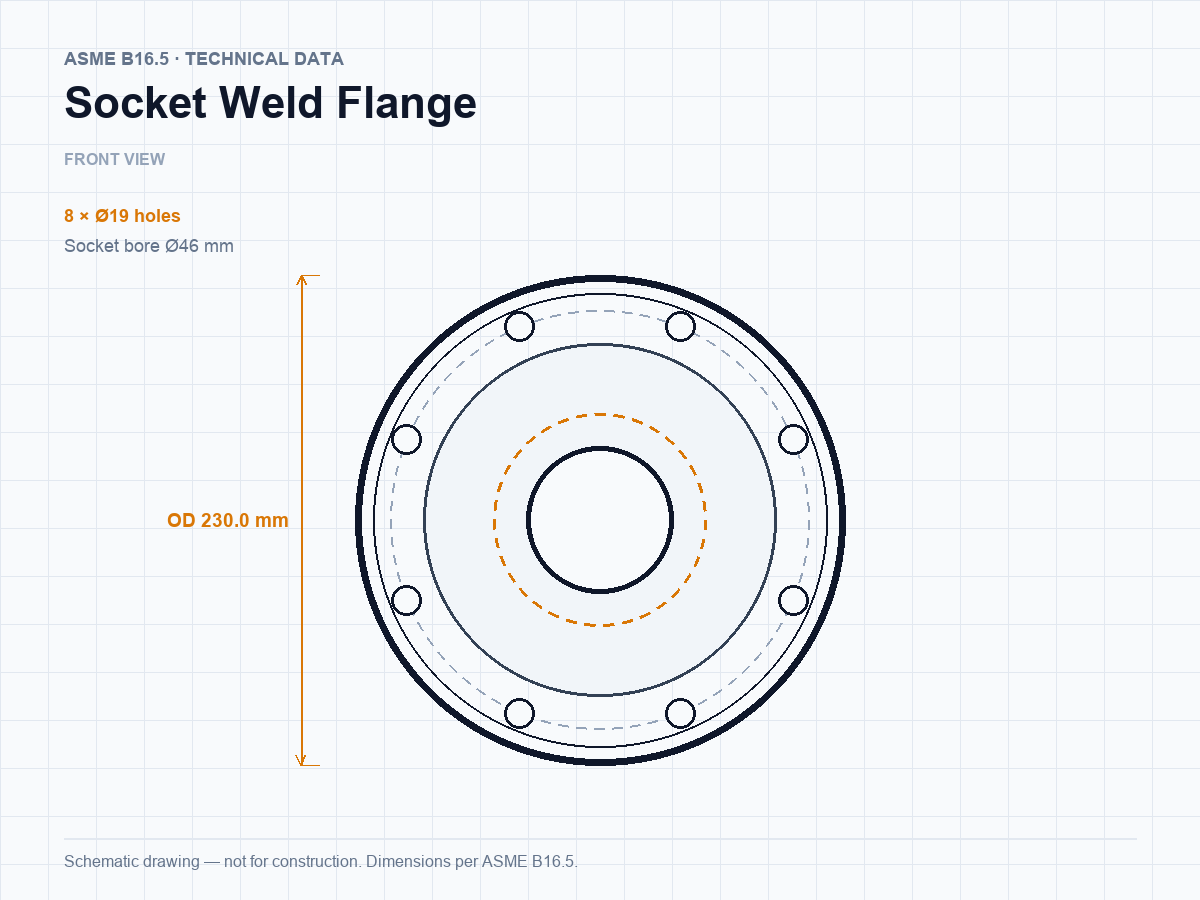
Socket weld flanges are used on small-bore, high-pressure lines — instrument tubing, sample systems, hydraulic skids and utility headers — where a fillet-welded socket joint is faster and more consistent than a butt weld.
Standard
ASME B16.5
Size range
1/2″–4″
Pressure class
150 / 300 / 600 / 900 / 1500 / 2500
Materials
A105, A350 LF2, 304/316L, F11/F22
Bore
Socket per ASME B16.5, schedule matched
Faces
RF, FF, RTJ
A socket weld flange has a recessed bore that accepts the pipe, which is inserted to a controlled depth and fillet-welded at the shoulder. The socket holds the pipe concentrically, so fit-up is quick and the weld is easy to inspect on small diameters where a butt weld would be difficult to align. B16.5 covers socket weld flanges from 1/2″ to 4″ (larger sizes are available to B16.47 on request).
The design has one important limitation: the expansion gap at the bottom of the socket must be maintained during welding, and the joint is not suitable for severe cyclic service or for lines that will be radiographed. We machine socket depth, bore and shoulder to B16.5, and can supply the flange with a matching socket-weld valve or fitting so the whole small-bore assembly comes from one heat. Materials include A105, A350 LF2, 304/304L, 316/316L and F11/F22.
Key features
Self-aligning socket
The recess centres the pipe automatically, cutting fit-up time on instrument and small-bore runs where access is tight.
Controlled weld gap
Socket depth is machined to leave the specified expansion gap at the shoulder, avoiding the cracking associated with bottomed-out welds.
Small-bore consistency
Bores and shoulders are machined in one setup, so flanges, valves and fittings in the same size stack up cleanly.
High-pressure ratings
Available through Class 2500 for hydraulic, sampling and injection lines where space is limited.
Typical applications
- Instrument and impulse lines
- Sample systems and analyser houses
- Hydraulic power units and skids
- Small-bore steam and condensate headers
- Chemical injection packages
- Compressed gas manifolds
Quality control & documentation
- Socket depth and bore measured on every lot
- Visual inspection of the socket shoulder and face
- PMI on stainless and alloy heats
- MTC 3.1 with heat-number traceability
Material certificates to EN 10204 3.1 are issued with every shipment; third-party inspection (SGS, BV, TÜV) can be arranged on request.
Frequently asked questions
When should I use socket weld instead of weld neck?
Socket weld is normally limited to small-bore lines (1/2″–4″) in moderate service. Use weld neck for larger sizes, cyclic duty, severe corrosive service or where the joint must be radiographed.
What is the correct gap at the bottom of the socket?
A gap of about 1.6 mm (1/16″) should remain between the pipe end and the socket shoulder before welding, to allow for thermal expansion. The gap is specified in ASME B31.3 and should be checked with a feeler gauge.
Can you match the socket to a specific pipe schedule?
Yes — tell us the pipe NPS and schedule and we will machine the socket bore and depth to suit, so the pipe inserts to the correct depth without modification.
Request a quotation
Send your socket weld flange specification
Include the standard, size, pressure class, material, face type and quantity. Drawings are welcome — we will confirm feasibility, lead time and price within one business day.
- ★ Reply within 24 hours on business days
- ★ MTC 3.1 and dimensional report with every order
- ★ FOB, CIF and DDP terms available
Send an Inquiry
Send drawings, dimensions or a standard reference. Our sales engineers reply within 24 hours on business days.