Forged Components — Open Die, Closed Die and Ring Rolling
Forgings are specified where strength, toughness and fatigue life cannot be guaranteed by casting or machining from bar. The forging process aligns grain flow with the load path and closes internal porosity, so the part performs better in service and can be certified by ultrasonic testing.
We forge carbon, alloy, stainless and duplex steel, heat treat in-house, and machine to drawing. Products range from 20-tonne open-die shafts to 500 kg closed-die parts and seamless rings up to 4000 mm outside diameter.
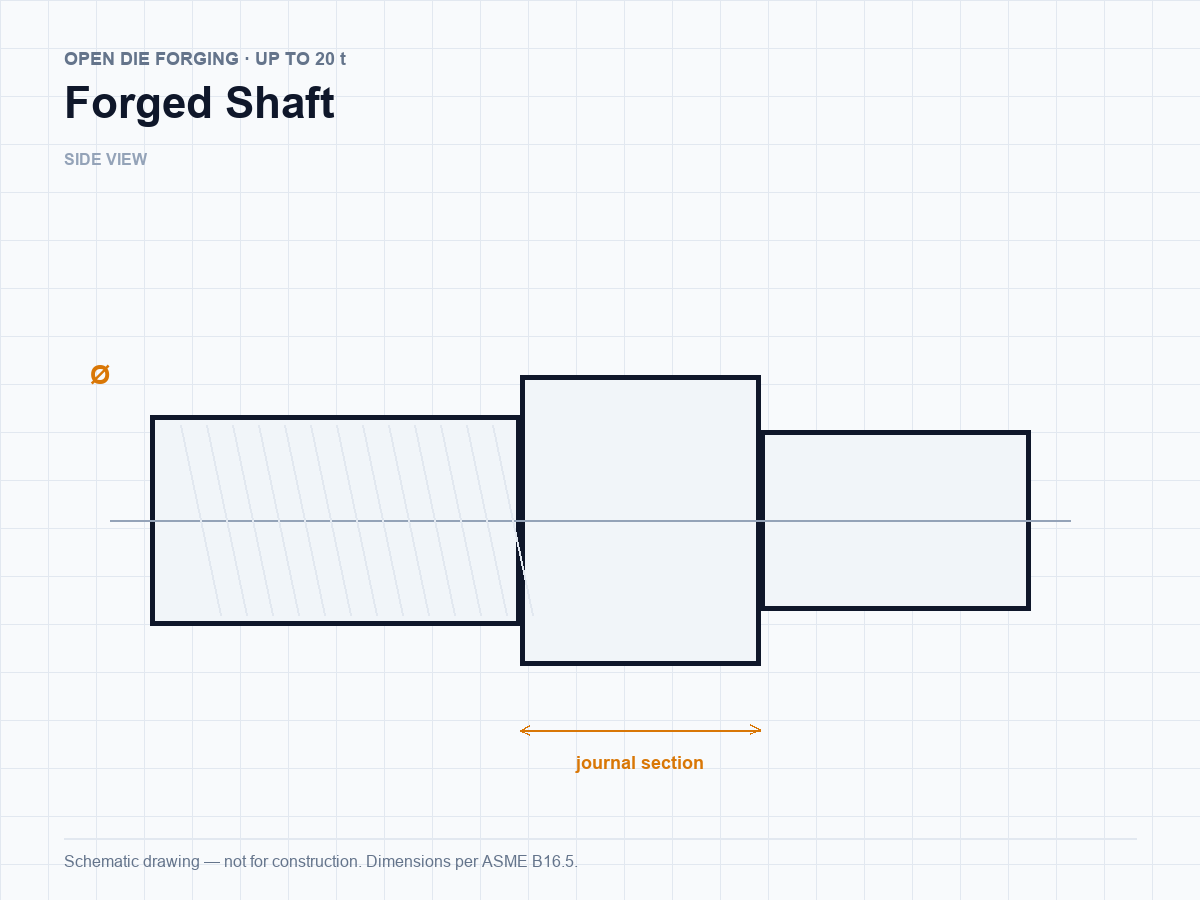
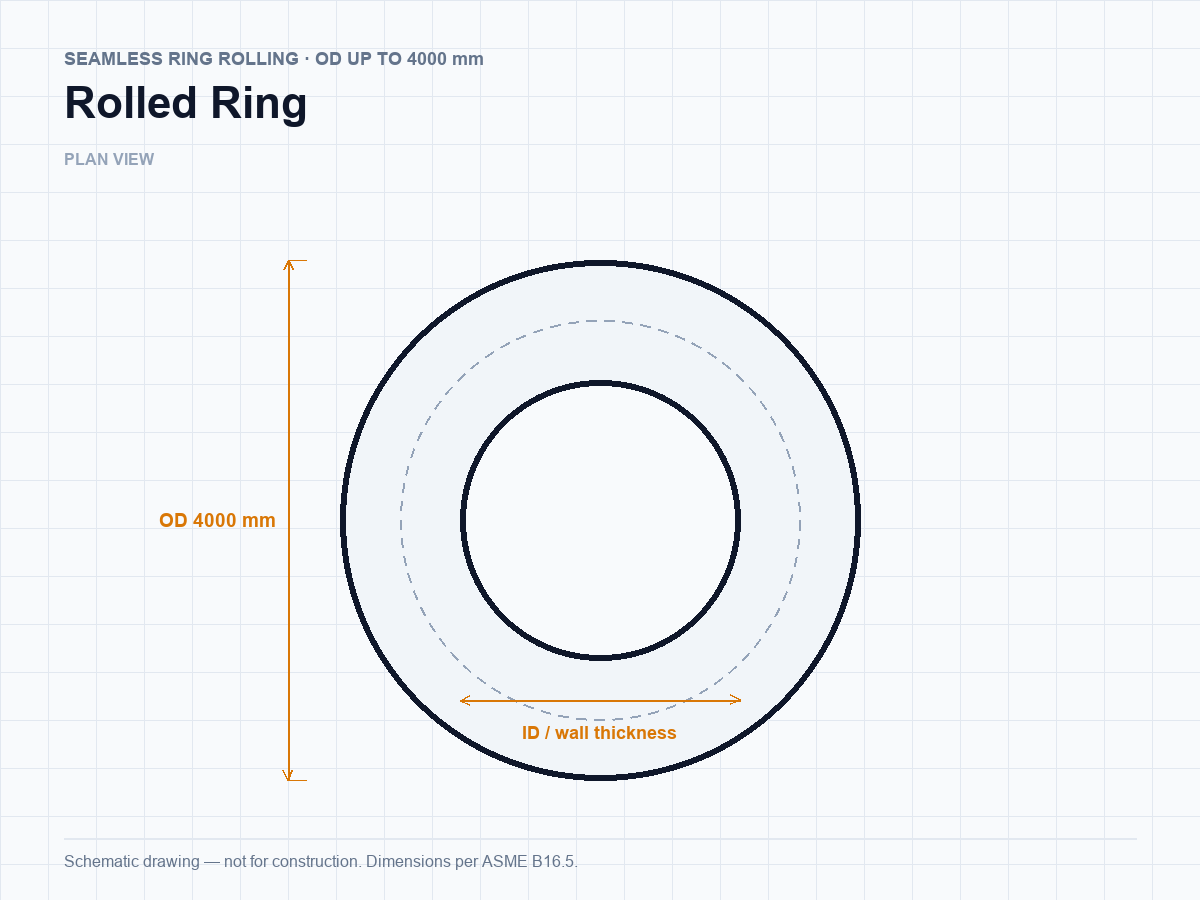
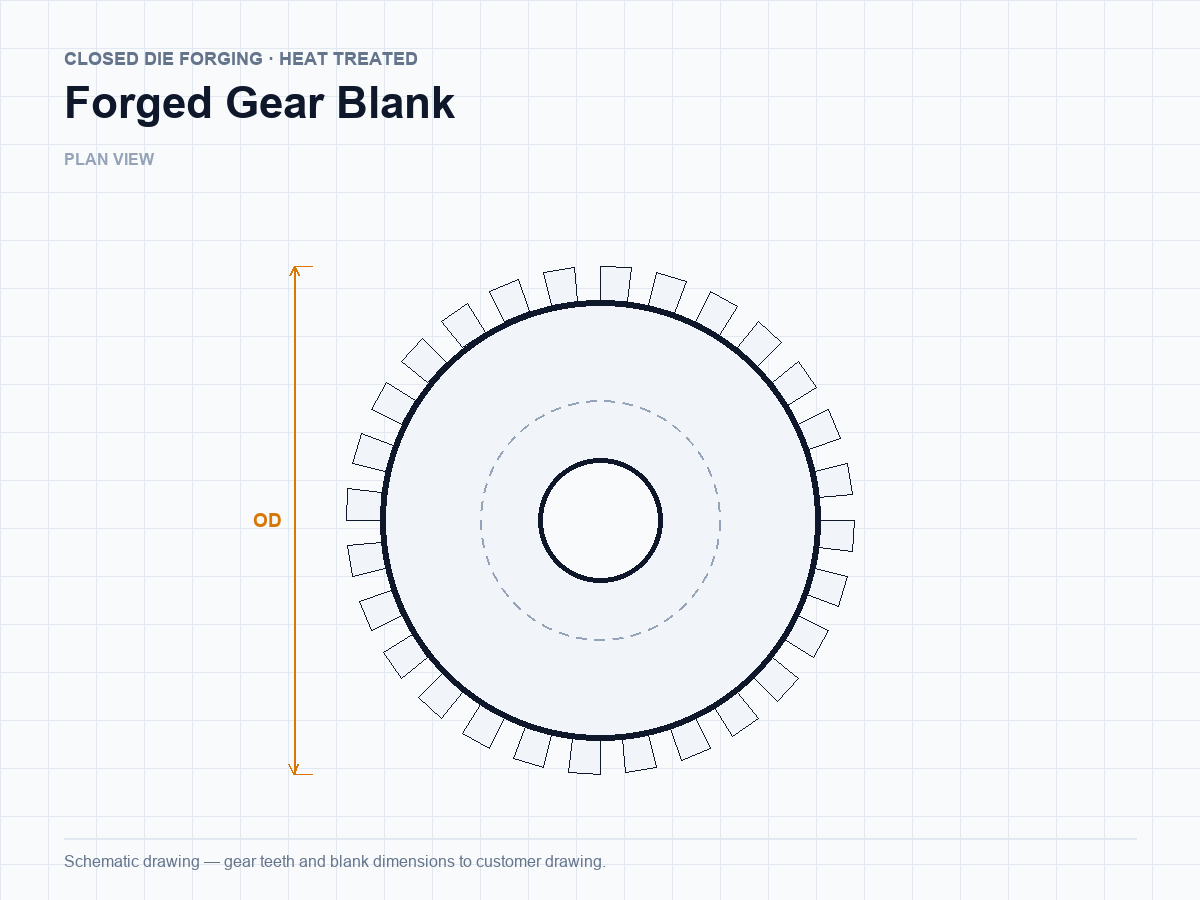
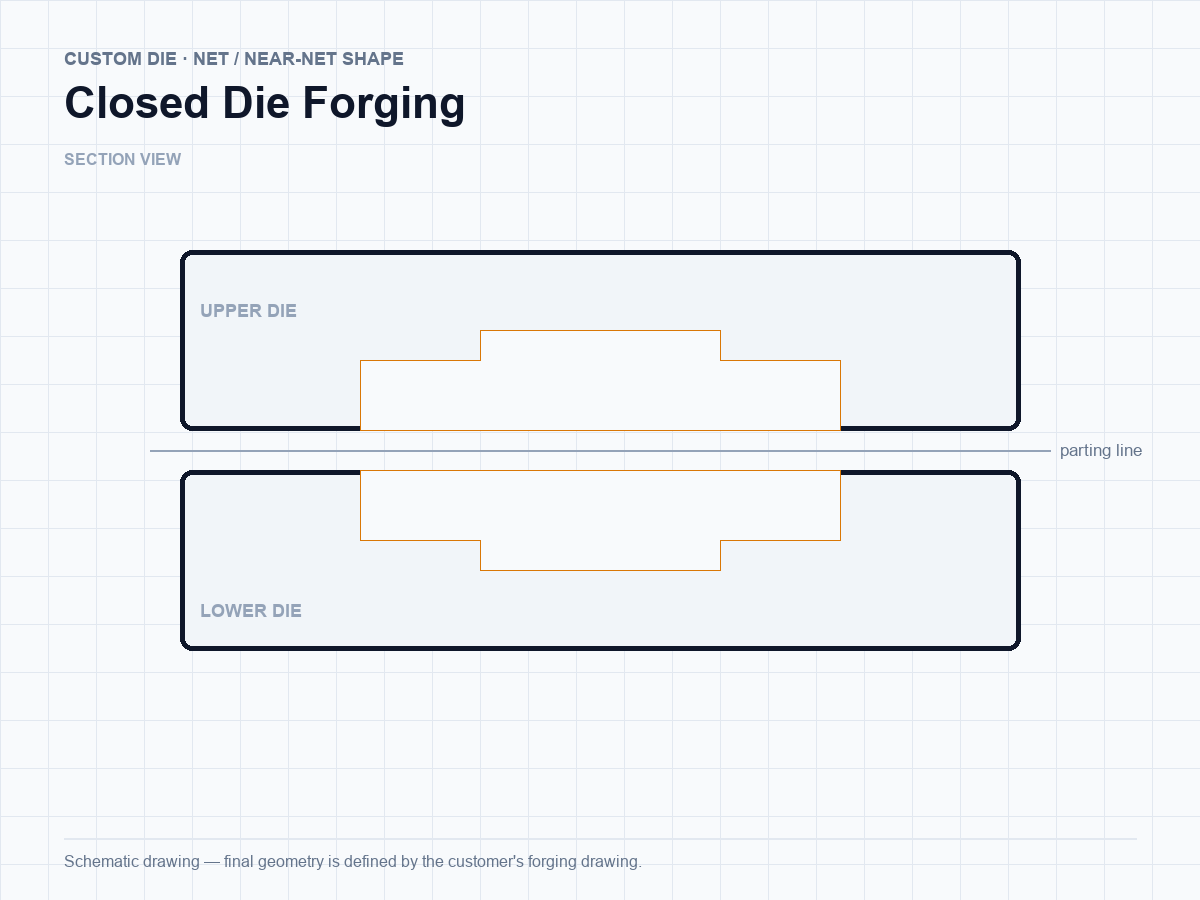
Choosing a forging process
| Process | Typical parts | Size / weight | Why it is chosen |
|---|---|---|---|
| Open die | Shafts, blocks, rings | Up to 20 t | Grain flow along the axis; UT after heat treatment |
| Closed die | Complex structural parts | 0.5–500 kg | Near-net shape; repeatable dimensions; die tooling |
| Ring rolling | Bearing races, flanges | OD 200–4000 mm | Seamless; circumferential grain flow; near-net profile |
Read more about how the three forging processes compare, or send a drawing for a feasibility review.
Heat treatment and testing
Forging sets the grain flow; heat treatment sets the properties. Carbon and low-alloy parts are normally normalised, while shafts and gears in 4140/4340 are quenched and tempered to the required strength. Furnace charts and test coupons are retained against the heat number.
Ultrasonic testing to ASTM A388 is standard for large forgings after heat treatment; magnetic particle or penetrant testing covers surface defects. Mechanical tests report tensile strength, yield, elongation and Charpy impact where specified.
What to send for a quote
- Drawing with tolerances and machining allowance
- Material grade and heat-treatment condition
- Quantity per year or per order
- Forging ratio or UT acceptance criteria, if critical
- Destination port and required delivery date
Why grain flow matters
Cast metal has a random, coarse grain structure and internal shrinkage. Forging works the metal while hot, so the grains elongate in the direction of flow and internal porosity closes. A shaft forged and drawn along its axis has its strongest orientation where the bending and torsional stresses act.
The same effect explains why a forged gear outlasts one cut from bar: the grain follows the tooth root instead of being severed at the point where bending fatigue cracks start. Forging ratio, reduction schedule and heat treatment together determine whether those properties are actually delivered.
Documents with every forging
Large forgings ship with an EN 10204 3.1 certificate, ultrasonic test report to ASTM A388 (or the specified standard), dimensional record and, where required, a hardness survey. Test coupons are taken from the same heat and heat treated with the part.
For class-approved or safety-critical parts, add third-party witnessing and a 3.2 certificate at the quotation stage — it changes the inspection schedule, so it cannot be added after the forging is complete.
Lead times depend on tooling and heat treatment: open-die shafts 3–6 weeks, rings 3–8 weeks, closed-die parts 6–10 weeks including a new die set. Plan the die approval and the first-article review into the schedule — they are the steps that decide whether the production run starts on time.