Material group · ASME B16.5 / EN 1092-1
Alloy Steel Flanges & Forgings — F11, F22, F91, 4140
Alloy steel grades are specified where carbon steel runs out of creep strength or where higher hardness and wear resistance are needed — refinery hydroprocessing, power generation and high-pressure steam.
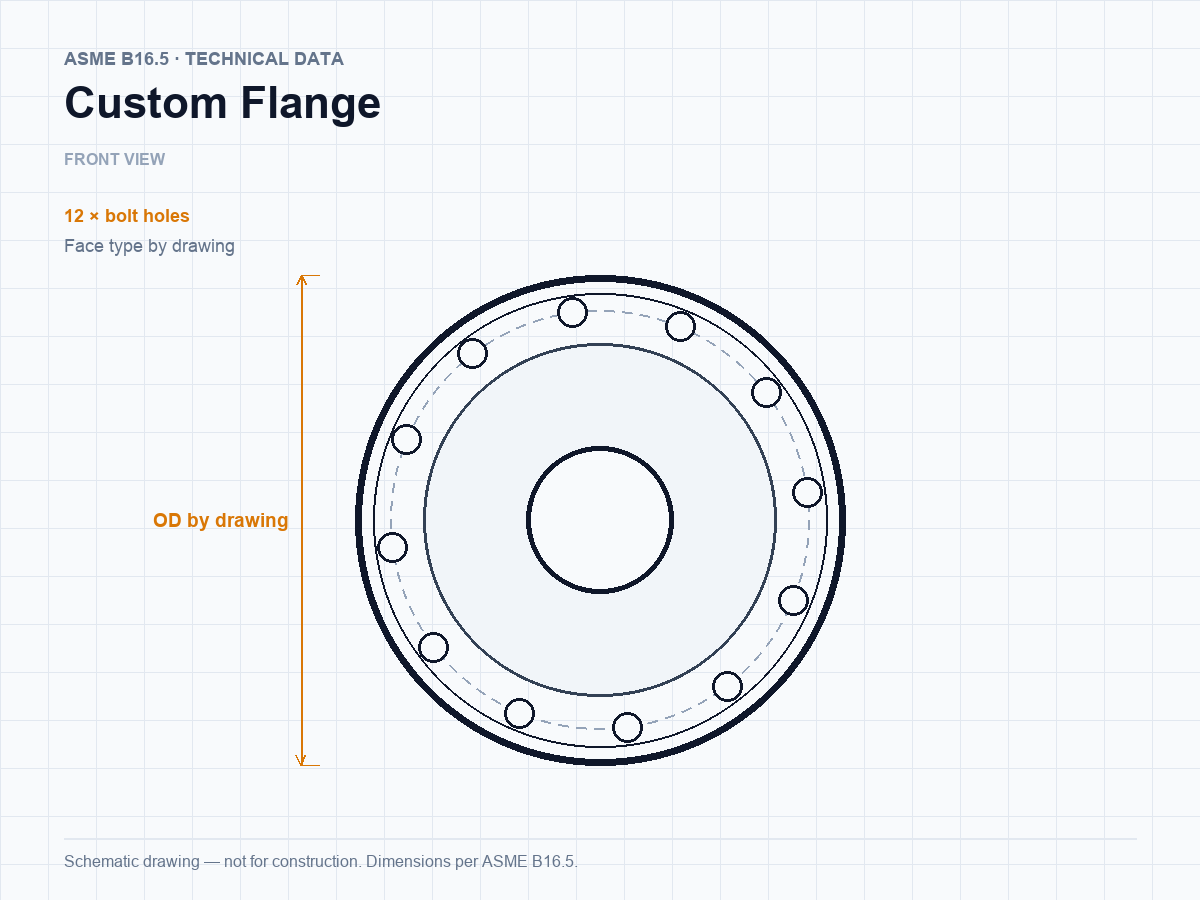
Chromium-molybdenum grades F11 (1¼Cr-½Mo) and F22 (2¼Cr-1Mo) are the standard alloys for high-temperature, high-pressure piping in refineries and power plants. F91 (9Cr-1Mo-V) offers much higher creep strength for advanced steam conditions and is used in main steam and reheat lines. F5 and F9 cover 5% and 9% chromium duty where oxidation resistance matters.
These grades require careful heat treatment and welding — preheat, controlled interpass temperature and post-weld heat treatment — and are supplied normalized and tempered with hardness and mechanical tests reported. For mechanical components we forge 4140 and 4340 for shafts, gears and couplings, quenched and tempered to the required strength level. Alloy steel flanges are dimensionally identical to carbon steel flanges of the same class, so they can be substituted without changing the piping layout.
Grades we machine and forge
| Grade | Specification | Service temperature | Typical use |
|---|---|---|---|
| ASTM A182 F5 | 5Cr–½Mo | up to 650 °C | Refinery and power piping, oxidation resistance |
| ASTM A182 F9 | 9Cr–1Mo | up to 650 °C | High-temperature process lines |
| ASTM A182 F11 | 1¼Cr–½Mo | up to 590 °C | Steam and hydroprocessing piping |
| ASTM A182 F22 | 2¼Cr–1Mo | up to 590 °C | Refinery reactors, high-pressure steam |
| ASTM A182 F91 | 9Cr–1Mo–V | up to 625 °C | Advanced steam, main steam and reheat lines |
| AISI 4140 / 4340 | Chromoly forging grades | −40 to 400 °C | Shafts, gears, couplings, high-strength parts |
Selection notes
- F22 and F91 require controlled welding procedures and post-weld heat treatment; we supply the matching PWHT data on request.
- Hardness is verified on every heat; F22 is typically limited to 237 HB for sour service.
- Alloy steel flanges are dimensionally interchangeable with carbon steel flanges of the same class and size.
Welding and fabrication
- F11 and F22 require preheat (typically 150–250 °C) and post-weld heat treatment to avoid hard, crack-sensitive heat-affected zones.
- F91 needs a closely controlled PWHT cycle below the tempering temperature of the base metal; the procedure must be qualified.
- Dissimilar joints between alloy and carbon steel need a qualified transition and the correct filler metal.
- Hardness surveys after PWHT are the practical check that the thermal cycle did what the procedure intended.
How to order
- State the design temperature and pressure so the allowable stress and grade can be checked.
- Give the welding procedure number and PWHT requirement if the flanges will be welded in a coded system.
- Specify impact testing where the design temperature is low or the project requires it.
- Confirm whether the parts must be supplied in the normalized, normalized-and-tempered or quenched-and-tempered condition.
Common specification mistakes
- Ordering a grade without stating the certificate level — 3.1 is the baseline, not an upgrade.
- Using 304/316 instead of the L grades on welded assemblies, then finding sensitisation at the weld.
- Treating a PN rating and an ASME class as interchangeable; the pressure may match and the bolt pattern will not.
- Specifying a material for sour service without checking the NACE hardness limit and heat-treatment condition.