ISO 9001 · EN 10204 3.1
Forged Shaft Manufacturer — Open Die, Heat Treated, Machined
Open-die forged shafts carry the highest loads in rotating equipment. Forging aligns the grain flow along the axis, closes internal porosity and gives a tougher part than a machined bar or casting.
Process
Open die forging, upsetting and drawing
Max weight
Up to 20 t per piece
Materials
45#, 42CrMo4, 4140, 4340, F11/F22
Heat treatment
Normalizing, Q&T, annealing
Testing
UT (A388), tensile, impact, hardness
Machining
Rough or finish machined to drawing
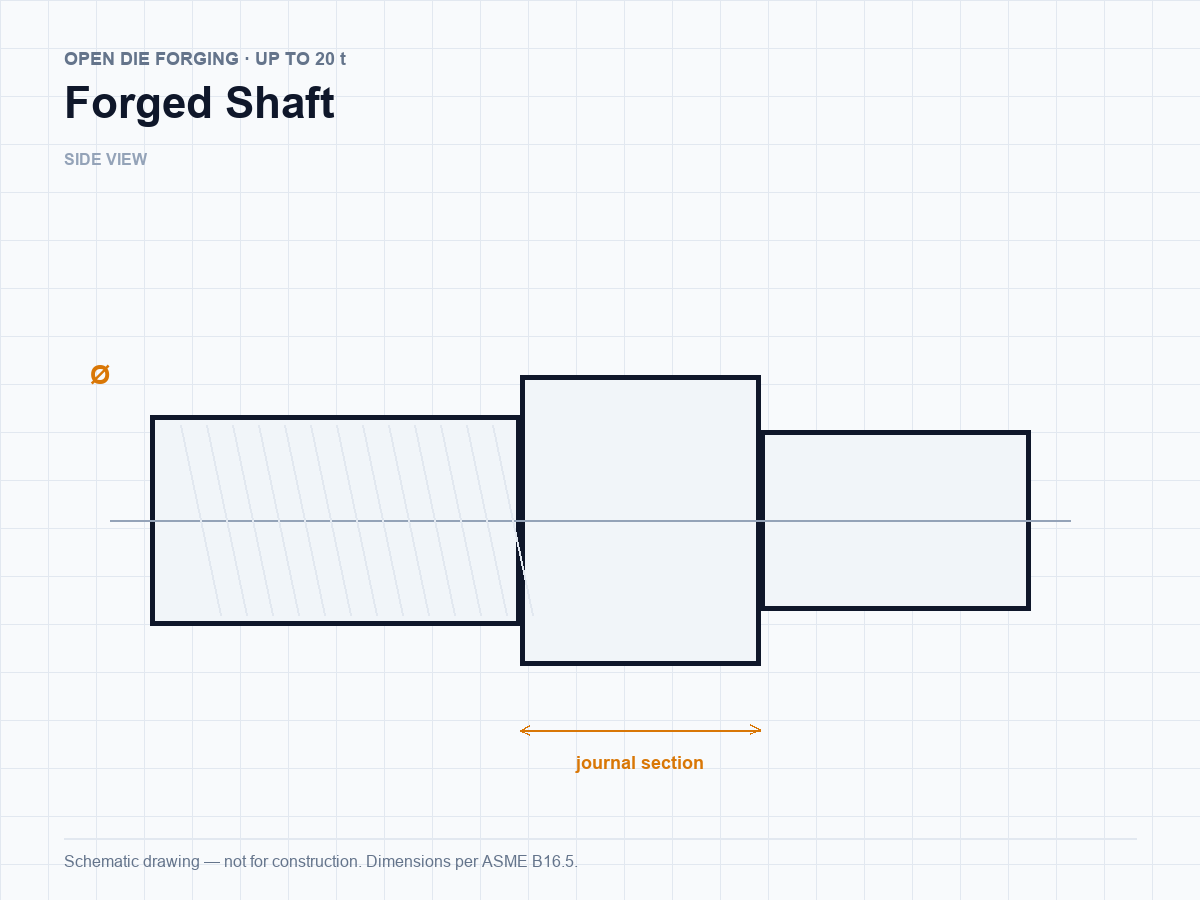
We forge shafts from ingots and billets up to 20 t, then rough-machine and heat-treat to the required mechanical properties. Typical products include stepped shafts, generator and motor shafts, pump shafts, pinions, rolls and marine propeller shafts. The forging ratio, reduction schedule and heat treatment are recorded for each order so the mechanical properties can be traced back to the process.
Carbon steel (45#, 42CrMo4, AISI 4140/4340) and alloy steel grades are supplied normalized, quenched and tempered, or case hardened. Ultrasonic testing to ASTM A388 or customer specification is performed after heat treatment, and the finished part can be machined to ISO 2768-mK or to your drawing with keyways, splines, threads and tapers.
Key features
Grain flow along the axis
Forging elongates the grain structure in the direction of loading, improving fatigue and impact toughness compared with bar stock.
Internal soundness
Forging closes porosity and segregations in the ingot core; UT after heat treatment confirms freedom from harmful defects.
Large section capability
Open-die equipment handles diameters and lengths that are not available in rolled bar, including stepped and flanged profiles.
Full heat-treatment control
Furnace charts, quench records and test coupons are retained, so mechanical properties can be verified against the specification.
Typical applications
- Pump and compressor shafts
- Generator and motor shafts
- Marine propeller shafts
- Rolling mill rolls and pinions
- Gearbox shafts and spindles
- Hydraulic cylinder rods
Quality control & documentation
- Chemical analysis and mechanical tests per heat
- UT to ASTM A388 after heat treatment
- Hardness mapping on large sections
- Dimensional inspection against the drawing
Material certificates to EN 10204 3.1 are issued with every shipment; third-party inspection (SGS, BV, TÜV) can be arranged on request.
Frequently asked questions
What is the maximum shaft weight you can forge?
Up to 20 t per piece for open-die shafts, depending on diameter and length. Send the drawing for a feasibility check.
Can you supply a shaft with keyways and splines?
Yes — we machine keyways, splines, threads, tapers and journals after heat treatment, and can hold ISO 2768-mK or your stated tolerances.
Which UT standard do you use?
ASTM A388 is standard for large forgings; we can also work to EN 10228-3 or your project specification, with acceptance criteria agreed before forging.
Request a quotation
Send your forged shaft specification
Include the standard, size, pressure class, material, face type and quantity. Drawings are welcome — we will confirm feasibility, lead time and price within one business day.
- ★ Reply within 24 hours on business days
- ★ MTC 3.1 and dimensional report with every order
- ★ FOB, CIF and DDP terms available
Send an Inquiry
Send drawings, dimensions or a standard reference. Our sales engineers reply within 24 hours on business days.