Forging is chosen when a part has to survive load, fatigue or impact. Casting can produce a shape more cheaply, and machining from bar can hold tighter tolerances, but neither gives the continuous grain flow and internal soundness of a forged part. The three main processes — open die, closed die and ring rolling — differ in how the metal flows, what tooling costs and what shapes are practical.
Why forging works
A cast ingot has a coarse, segregated internal structure with shrinkage porosity. Forging works the metal while it is hot: the grains elongate in the direction of material flow, porosity is closed, and the resulting part has better toughness and fatigue resistance in the direction that matters.
The amount of work is expressed as the forging ratio (or reduction ratio): the original cross-section divided by the finished cross-section. A higher ratio means more deformation and generally better consolidation, but it also means more operations and higher cost. For critical shafts, a ratio of 3:1 or more is common; for simple blocks, less may be acceptable.
Grain flow direction is the reason a forged gear outlasts a gear cut from bar. In a forging, the grain follows the tooth root; in a machined part, the grain is cut through at exactly the point where bending fatigue starts.
Open-die forging
Open-die forging uses flat or simple contoured dies. The workpiece is manipulated between strokes, so the shape is controlled by the operator and the manipulation pattern rather than by a die cavity.
Best for: large parts, low-to-medium quantities, simple-to-moderate shapes, and cases where the ingot must be consolidated.
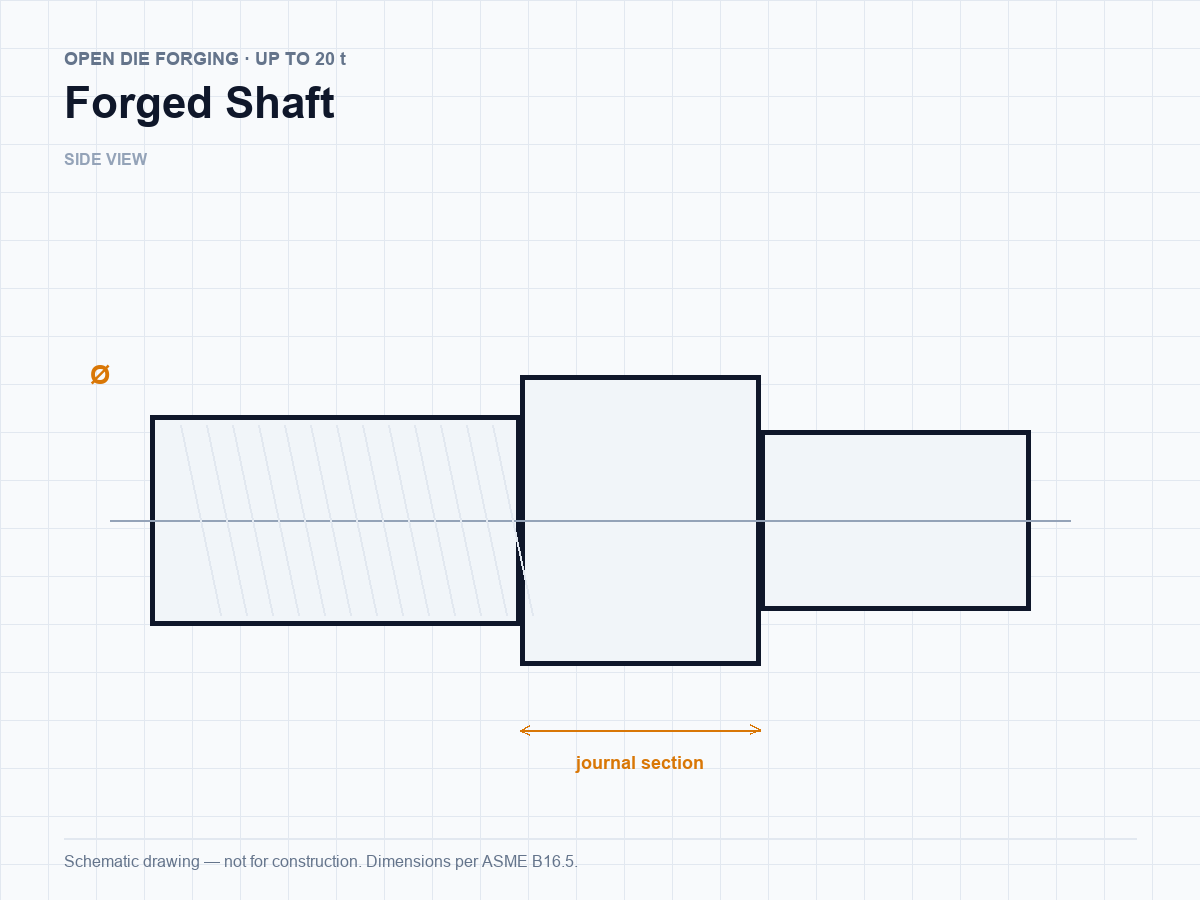
Typical products: stepped shafts, discs, blocks, hubs, rings, marine shafting, mill rolls.
Advantages
- Almost no tooling cost — the economics work from one piece upward.
- Very large sizes are possible: we forge shafts up to 20 t.
- The whole cross-section is worked, which closes internal porosity.
- Grain flow can be aligned with the principal stress direction by choosing the drawing direction.
Limitations
- Loose tolerances and significant machining allowance.
- Shape complexity is limited; undercuts and thin sections are not practical.
- More dependent on operator skill than a die-based process.
Closed-die forging
Closed-die (impression-die) forging forms the part in a machined die cavity. The die controls the shape, so the process produces a near-net part with repeatable dimensions.
Best for: small-to-medium parts in medium-to-high volumes, complex shapes, near-net requirements.
Typical products: connecting rods, yokes, levers, brackets, valve bodies, gear blanks, track links.
Advantages
- Near-net shape: less machining, less waste.
- Repeatable dimensions and surface finish piece to piece.
- Good grain flow following the part contour.
- High production rates once the die is proven.
Limitations
- Die tooling is a real cost, typically justified from several hundred pieces upward.
- Draft angles and fillets are required for the part to release from the die.
- Design changes mean die changes.
Ring rolling
Ring rolling starts with a pierced, donut-shaped preform. A driven roll and a mandrel expand the ring while the wall thickness is reduced, so the material flows circumferentially.
Best for: seamless rings, bearing races, gear blanks, large flanges, wind-turbine rings.
Typical products: bearing rings, slewing rings, gear blanks, pressure-vessel rings, large flanges.
Advantages
- Seamless: no weld, no weld inspection, no heat-affected zone.
- Circumferential grain flow, which matches hoop stress in a ring.
- Near-net profiles reduce machining on large parts.
- Outside diameters up to about 4000 mm.
Limitations
- The process is for rings, not general shapes.
- Tooling for profiled rings is part-specific.
- Wall-thickness and diameter tolerances still require machining for precision parts.
Comparing the three processes
| Criterion | Open die | Closed die | Ring rolling |
|---|---|---|---|
| Part weight | ~100 kg to 20 t | 0.5–500 kg | 10 kg to several tonnes |
| Quantity | 1–100 | 500–50,000+ | 1–10,000+ |
| Shape complexity | Low–medium | High | Ring only |
| Tooling cost | Very low | High | Medium |
| Machining allowance | Large | Small | Small–medium |
| Grain flow | Axial, controlled by drawing | Follows contour | Circumferential |
| Typical lead time | 3–6 weeks | 6–10 weeks incl. tooling | 3–8 weeks |
Heat treatment after forging
Forging is only half the process. The properties the buyer relies on come from the heat treatment that follows:
- Normalising refines grain size and gives a uniform structure — common for carbon and low-alloy flanges.
- Quenching and tempering develops strength and toughness together, used for shafts, gears and 4140/4340 parts.
- Annealing softens the part for machining.
- Carburising adds a hard case for gears while keeping a tough core.
The heat-treatment cycle should be recorded, and for critical parts the test coupons should be heat treated with the production part, not separately.
Defects, inspection and the purchase order
Typical forging defects include laps and seams (surface), internal porosity or piping, coarse grain from overheating, and cracks from improper cooling. They are found by visual inspection, magnetic particle or penetrant testing for surface defects, and ultrasonic testing for internal ones.
A purchase order for a forging should state the process, material, forging ratio if critical, heat-treatment condition, machining stage, UT standard and acceptance criteria, and the test certificate type. Vague requirements (“forged, heat treated”) leave the supplier to decide all of those.
For more detail, see our forged shafts, rolled rings, forged gears and die forgings pages, or send a drawing for a process recommendation.