ISO 9001 · EN 10204 3.1
Forged Gear Blank Manufacturer — Closed Die, Heat Treated
A forged gear blank has continuous grain flow around the tooth root, which is where bending fatigue cracks initiate. That is why forged gears outlast cast gears and gears cut from bar in high-torque drives.
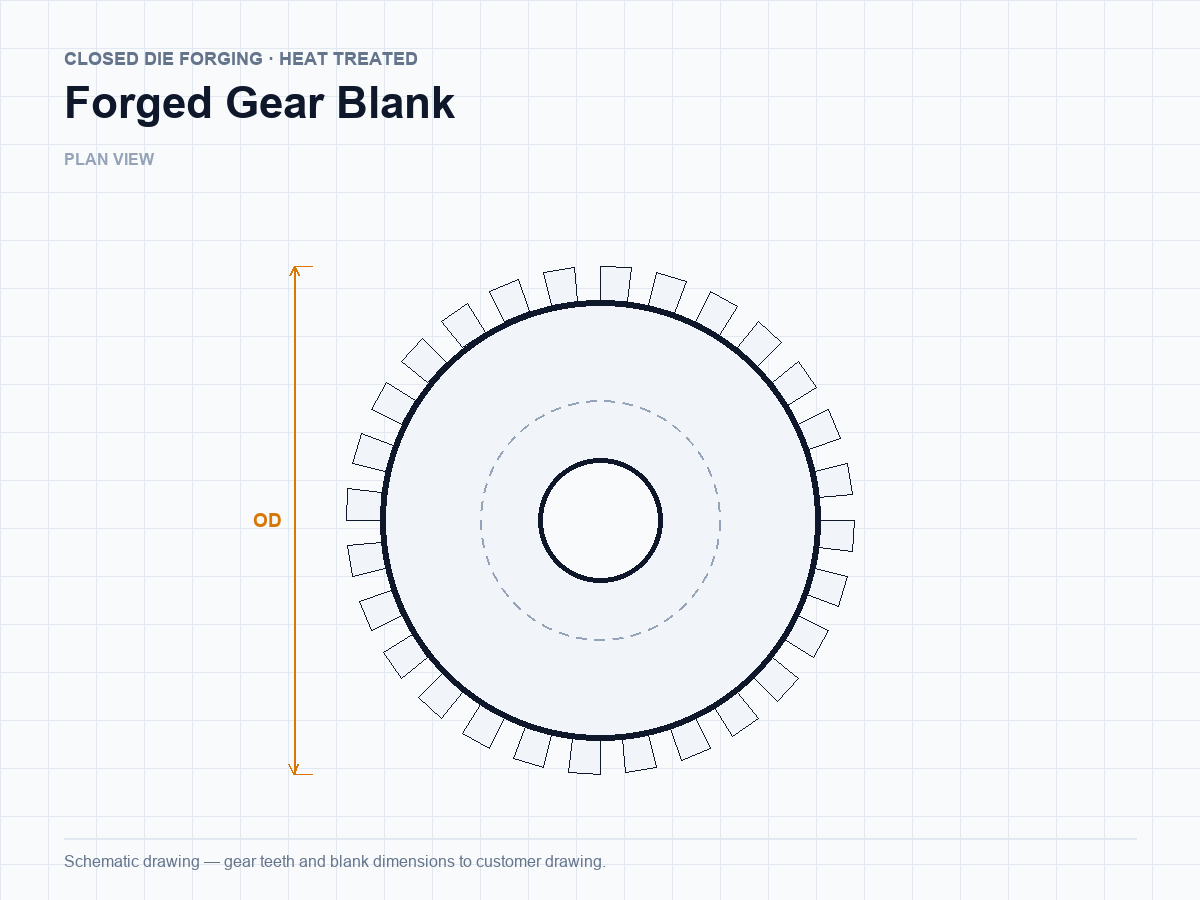
Process
Closed-die forging / rolled ring
Weight range
1–500 kg per piece
Materials
42CrMo4, 4140, 20CrMnTi, 17CrNiMo6
Heat treatment
Normalizing, Q&T, carburising, induction hardening
Machining
Bore, keyway, faces, reference diameters
Testing
Hardness, UT, dimensional, MTC 3.1
We produce closed-die forged gear blanks, pinions and ring gears from 1 kg to 500 kg, in carbon and alloy steel including 42CrMo4, 4140, 20CrMnTi and 17CrNiMo6. Forgings are normalized, quenched and tempered or carburised according to the duty, then machined to the gear-cutting drawing with the bore, keyway, faces and reference diameters finished.
The forging process keeps grain flow following the tooth profile instead of cutting through it, improving bending fatigue strength and impact toughness. For large ring gears we start from a rolled ring and machine the teeth after heat treatment, which avoids distortion and keeps concentricity. Inspection includes chemical and mechanical tests, hardness, UT on larger parts and dimensional reports against the drawing.
Key features
Grain flow around the tooth root
Closed-die forging follows the tooth profile, so the grain is not cut through at the root — the usual fatigue initiation site.
Near-net shape
Forging to near-net shape reduces machining time and material waste compared with cutting from a solid bar.
Controlled heat treatment
Carburising depth, case hardness and core toughness are specified and verified for each batch.
Distortion control
Teeth are cut after heat treatment on large ring gears, so concentricity and lead are not lost in the quench.
Typical applications
- Industrial gearboxes and reducers
- Crane and hoist drives
- Mining and cement mill drives
- Wind-turbine gearboxes
- Marine propulsion gears
- Agricultural and off-highway transmissions
Quality control & documentation
- Chemical and mechanical tests per heat
- Hardness and case-depth checks
- UT on blanks above 50 kg
- Dimensional report against the gear drawing
Material certificates to EN 10204 3.1 are issued with every shipment; third-party inspection (SGS, BV, TÜV) can be arranged on request.
Frequently asked questions
Do you cut the gear teeth or only supply blanks?
We supply forged and machined blanks, and can also cut teeth to your drawing if you provide the module, pressure angle, helix angle and quality grade.
Which material is best for a high-torque gear?
42CrMo4/4140 quenched and tempered is the workhorse for medium-to-high torque; 20CrMnTi or 17CrNiMo6 carburised grades are used where surface hardness and core toughness are both required.
Can you forge a gear with a non-standard hub or web?
Yes — the die is made to your drawing, including hub, web, lightening holes and clamping features. Tooling lead time is typically 4–6 weeks.
Request a quotation
Send your forged gear specification
Include the standard, size, pressure class, material, face type and quantity. Drawings are welcome — we will confirm feasibility, lead time and price within one business day.
- ★ Reply within 24 hours on business days
- ★ MTC 3.1 and dimensional report with every order
- ★ FOB, CIF and DDP terms available
Send an Inquiry
Send drawings, dimensions or a standard reference. Our sales engineers reply within 24 hours on business days.